Thursday, October 31, 1:49 am
Upcoming Events
I'll be giving a few talks over the next month:
* On Monday, November 3rd, I'll be giving a lecture at the American Research Institute in Turkey. The talk starts at 6:30 pm and is called "Marketing Modern Identity in the Late Imperial Era: Yusuf Akçura and Ahmet Ağaoğlu in Russia and the Ottoman Empire."
* On Friday, November 21, I'll give a presentation at the annual meeting of the American Association for the Advancement of Slavic Studies. The meeting is going to be in Philadelphia this year. The name of my talk is "The Pan-Turkist Specter: Russia and the Threatening Nature of Muslim Mobility."
* On Tuesday, November 25, I'll be giving another presentation at the annual meeting of the Middle East Studies Association, which this year is taking place in Washington, DC. The name of my presentation is "Rethinking the Intellectuals: Yusuf Akçura and Ahmet Ağaoğlu in Russia and the Ottoman Empire."
Sunday, September 21, 9:40 pm
Volga-Ural Conference in Kazan
This past Friday and Saturday a conference entitled "The Volga-Ural Region as a Crossroads of Eurasia: Empire, Islam, and Nationality" was held at Kazan State University. The conference organizers were the Islamic Area Studies Center at the University of Tokyo, Kazan State University, and the Slavic Research Center of Hokkaido University.
I only attended the Friday sessions of the conference and the post-conference party on Saturday night. It was super seeing a lot of old friends and acquaintances from the US, Japan, Kazan, Ufa, and Turkey, including Hisao Komatsu, Rafik Mukhametshin, Charles Steinwedel, Il'dus Zagidullin, Diliara Usmanova, Norihiro Naganawa, İsmail Türkoğlu, Azat Akhundov, Masumi Isogai, Marsil Farkhshatov, Mami Hamamoto, Xavier Le Torrivellec, and others. I also got to know a number of other specialists on the region that I hadn't previously met--all in all a great time! At the post-conference party, talk flowed in Russian, Tatar, and Turkish--a perfect Kazan send-off!
Monday, July 28, 10:13 am
Book Review: Robert D. Crews’ For Prophet and Tsar
Robert D. Crews’ For Prophet and Tsar: Islam and Empire in Russia and Central Asia (Harvard University Press, 2006) is one of the more interesting and thought-provoking works to emerge from the growing list of studies that have been produced over the past two decades with regard to the Muslim communities of late imperial Russia. Following on the heels of the work of Danil’ D. Azamatov (in particular, his masterly Orenburgskoe Magometanskoe dukhovnoe sobranie v kontse XVIII-XIX vv.), Crews’ study is an examination of the role of “official” Islam in the Russian Empire, and of the Orenburg Muslim Spiritual Assembly in particular.
There is much to like about this book. It is well-written and very provocative. In my opinion, the book’s principal strength lies in its depiction of the undertakings and objectives of tsarist officials. Whereas much of the historiography prior to Crews viewed Catherine the Great’s creation of the Orenburg Assembly through the prism of Enlightenment and tolerance, Crews perceptively zeroes in on the strategy behind toleration: control. In so doing, Crews moves this work beyond simply a study of Islam in Russia to interrogate Enlightenment thinking more generally. Despite various shortcomings (described below), For Prophet and Tsar constitutes an important contribution to scholarship relating to the efforts of the tsarist state to administer a vast and diverse population. Indeed, Crew’s conceptualization of Russia as a “multi-confessional empire” is itself a significant contribution to ongoing efforts among historians of the Russian Empire to better articulate the nature of imperial Russia.
That being said, even with respect to Crews’ treatment of the state—which is the book’s main strength—there are some problematic aspects to this work. While the dissertation from which this book was adopted was mainly a history of the Orenburg Spiritual Assembly, For Prophet and Tsar tackles the much more ambitious project of discussing relations between the state and Islam in all of Russia. This is a much more complicated task, particularly since there was not just one Muslim spiritual assembly in Russia, but four. Indeed, each of these four assemblies were governed by their own rules and traditions, and each of them shared distinct sets of relations with both state officials and their own local Muslim populations. Moreover, other regions of the empire were effectively without any formal spiritual assembly jurisdiction, and were administered in much different ways. Yet for Crews, the “Muslims” discussed in For Prophet and Tsar appear to be mainly the Muslims of the Volga-Ural region, whose experiences have been generalized to cover all of Russia. While there are certainly many similarities with respect to the various arrangements under which the diverse Muslim communities of Russia were governed, there were also many important differences, none of which are well described in this book.
Just as Crews often generalizes the experiences of Volga Muslims onto the Muslim populations of the empire more generally, he also generalizes with respect to time. Indeed, there is little sense of overall historical change in this book, with each chapter jumping from one era to the next and back again. In particular, the importance of the Great Reforms to the administration of non-Muslim communities is ignored altogether. Instead, the Nikolaevan period appears to have been taken as a model to be beamed across the expanse of the nineteenth century until the Revolution of 1905.
While Crews’ discussion of the tsarist state is insightful and, in some ways, even path-breaking, his discussion of Muslim populations in Russia is considerably more problematic. This is particularly the case with regard to Crews’ depiction of the attitudes of Muslims towards the state.
Crews’ argument is that, for Muslims, “religion came to depend on the institutions of the state” (10). Using the state to advance “true religion” (21), Muslims “solicited the intervention of courts and police to correct behavior that they judged to be contrary to the Sharia.” (95). “Threats to Islam,” argues Crews, “came more frequently from within the community” than from the state (96). The documents that Crews draws upon in making this argument are petitions written by Muslims to various authorities in the civil administration. The problem with For Prophet and Tsar is that Crews reads these petitions literally, rather than as discourses employed by Muslims for use in communications with tsarist officials.
Speaking to power, Muslims adopted the multi-confessional discourses used by the state while petitioning state officials. In a “multi-confessional” system of administration where the state held pretensions to both defining and upholding “Muslim Law” (including a state-based monopoly over the use of Sharia courts), it is not surprising that Muslims would likewise employ “Islamic” discourses when presenting their cases to state officials. In Russia, Muslims were obliged to have cases pertaining to marriage, divorce, and the division of property decided by the Sharia-based rulings of the Orenburg Spiritual Assembly. Why, then, would Muslims not emphasize the merits of their cases in Islamic terms when petitioning state officials?
But the fact that Muslims emphasized Islamic discourses in making their cases to tsarist officials hardly means that Muslims viewed the state as an Islamic authority or a defender of their religion. Rather, it means that Muslims—particularly those in the Volga-Ural region, who had been living under multi-confessional administration since the late eighteenth century—had learned to speak the multi-confessional language of tsarist officials when making their case to government offices. Indeed, this kind of vocabulary was a staple of Muslim administration in the Russian Empire, where such Islamo-administrative discourses originated with the state, not with its Muslim subjects.
Even more disturbing is the fact that in making his case Crews ignores crucial aspects of the historiography of Muslims in Russia, particularly episodes that call into question his rather benign view of Muslim-state relations. Over the course of two decades (1878-1897) at the end of the nineteenth century, Muslims in hundreds of villages across the Volga region—the very region upon which most of the research of For Prophet and Tsar is based—protested repeatedly, in the name of "Islam," against a number of newly implemented tsarist regulations. These protests took the form of petition campaigns, which likewise employed “Islamic” discourses, and were occasionally accompanied by violent public protests. For years, rumors repeatedly circulated across the region alleging that Muslims would be forcibly converted to Orthodox Christianity. At the very least, it would seem that these events—which constitute a major component of the regional historiography of the Volga region--would complicate Crews’ view that Muslims saw tsarist officials as "agents" of Islam (165), and would merit some attention. It would also have been nice to see at least some mention of some of the major works of regional historiography pertaining to Muslim communities in the empire, which appear to have been largely ignored in this study--perhaps a consequence of Crews' efforts to immunize himself from the "nationalist dictates that color the writing of history in the [Volga-Ural] region" (449).
It also needs to be noted that the "Islam" about which Crews writes in For Prophet and Tsar is basically that of official institutions (in particular the Orenburg Spiritual Assembly), which represented the Islam of the state. There was, however, an enormous and diverse Islamic civilization in Russia beyond the confines of the state which Crews hardly touches upon. While the Orenburg Assembly and other institutions of official Islam can, without question, constitute an excellent subject of research, Crews is mistaken in equating (even if only by omision) official Islam with Islam in the empire more generally. Although Crews does make the occasional acknowledgement of the existence of Islam beyond the scope of state institutions, most of the many generalizations he makes in For Prophet and Tsar about Muslims, the state, and "Islam" in Russia are directed primarily towards a discussion of official Islam, and not Islamic civilization in the empire more generally.
This is a 'big' book, which in many ways is a good thing--it goes beyond the particulars of events and endeavors to comment upon the nature of tsarist administration more broadly. Such efforts are bound to result in various omissions, mistakes, and generalizations. At issue in For Prophet and Tsar is not the mere presence of omissions, mistakes, and generalizations, but rather their scale and relative importance to the subject matter at hand. Big can be good, but only if a scholar is up to the task of presenting the issues at hand in a 'big' way. While this book has many fine qualities, and Crews' 'big' approach often works with respect to his treatment of the state's intentions, it ultimately founders on Crews' handling of the relationship between the state, Muslim communities, and Islam.
All in all, For Prophet and Tsar is a book I would nevertheless recommend to people interested in an introduction to Islam in Russia and Muslim administration. Indeed, it's one of the most interesting and intelligently-written books to come out on Russian imperial history in recent years. For those of us concerned with the question of how Muslims viewed the state, however, the book has some important flaws. I would therefore recommend For Prophet and Tsar with the strongly emphasized caveat that it be read critically and in conjunction with other studies on the region.
Monday, June 2, 6:51 pm
In the latest issue of the Central Eurasian Studies Review (Vol. 7/ number 1), Sean Pollock writes a summary of two workshops held at the Harriman Institute this year as part of the Russia-Islam project I was working on. One was entitled "Russia and Islam in the Archives of Eurasia: An International Workshop," and is discussed on pages 20-23 of the issue, and the other was called "Russia and the Ottoman Empire: Transregional and Comparative Approaches," and is reviewed on pages 30-33. I was the organizer of the second of these workshops.
Friday May 30, 2:02 pm
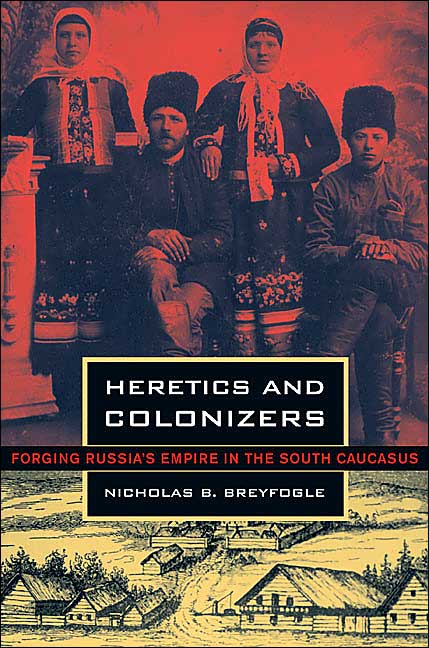
Book review: Nicholas Breyfogle's Heretics and Colonizers
I've been pretty busy lately preparing to leave New York, and one of the many tasks I've been tackling has been returning to Columbia's library the dozens of books I've got stacked all over my apartment and office. There are a number of books about which I'd like to write a few lines, without going through the bother of writing a full review, and this site seems like a good place to do it.
Nicholas Breyfogle's Heretics and Colonizers: Forging Russia's Empire in the South Caucasus (2005) focuses mostly upon the experiences of Dukhobor colonizers in the south Caucasus, although other Christian sectarian groups, such as the Molokans, are also discussed. There were a lot of things about this book that I really liked, and in general I believe that the appearance of so many studies in recent years which examine the empire from the perspective of the regions has been a great development for the field of Russian history. However, there are also a couple of points about this book that I'd like to bring up, mainly with respect to its depiction of the relations between the sectarian colonizers and the indigenous populations.Over the past couple of decades, there has been a great expansion in scholarship pertaining to the more peripheral regions of the Russian Empire and their (often non-Russian) populations. In Heretics and Colonizers, Breyfogle discusses the changing relationships between the tsarist state and a number of pacifist (Christian) sectarian communities in the nineteenth and early twentieth centuries. The communities are send to the newly conquered Caucasus as colonizers, originally as a punishment for their non-conformist behavior. As Breyfogle writes on p. 46: